
False Claim: Suicide Rates Are Rising in Canada
At a parliamentary press conference in Ottawa on April 13 opposing Medical Assistance in Dying (MAiD) where mental illness would be the sole underlying medical condition, Alex Schadenberg of the Euthanasia Prevention Coalition claimed that suicide deaths in Canada had risen sharply, citing figures of 3,973 in 2016, 3,927 in 2021, and 4,735 in 2023, to support his claim of “a greater than 20% increase over the 2-year period.”
Alex Schadenberg appeared to misunderstand earlier parliamentary testimony from Jocelyn Downie. The point made in that testimony was that if Medical Assistance in Dying (MAiD) for some people whose sole underlying condition is mental illness is continually delayed, some individuals may die by suicide. That is a sober and evidence-based observation, not a claim that allowing MAiD would reduce national suicide rates. We’ve written about that in more detail here. Alex Schadenberg seems to have conflated those two very different arguments. Regardless, the issue here is simpler: Schadenberg’s claim that suicide rates in Canada are rising sharply is not supported by the data.
First, the numbers cited do not appear to come from any single consistent Canadian source. They seem to be drawn from different datasets, using figures that best support the conclusion he wanted to reach.
Second—and more importantly—raw totals are not the proper way to assess long-term trends in a growing country. Canada’s population has increased significantly since 2016. Any serious statistical analysis should account for that. The more meaningful measure is the suicide rate per 100,000 population, not simply the total number of deaths.
Either Schadenberg understands this and chose not to mention it because it would undermine his narrative, or he does not understand it at all—which would reveal a striking level of statistical ignorance.
Either way, that is where the claim collapses.
What the official Canadian data shows
There are at least two major official Canadian sources commonly used for this topic:
Statistics Canada mortality tables
Public Health Agency of Canada Health Infobase suicide mortality data
When we examine them, neither supports the narrative of sharply rising suicide rates.
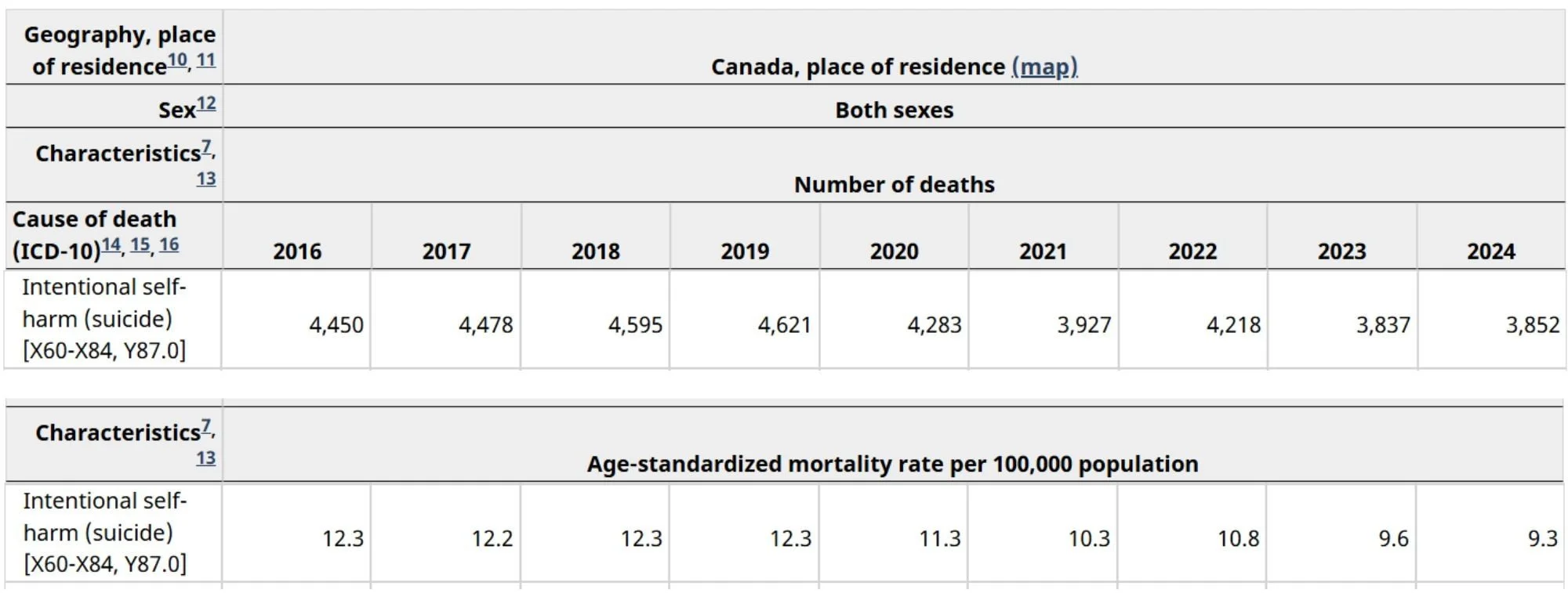
Statistics Canada data
Statistics Canada’s mortality tables show fluctuations in the total number of deaths year to year, but once population is considered, the suicide rate remains broadly stable—even decreasing in recent years—rather than rising dramatically.
Public Health Agency of Canada Health Infobase
The Health Infobase data shows the following national suicide rates per 100,000 population:
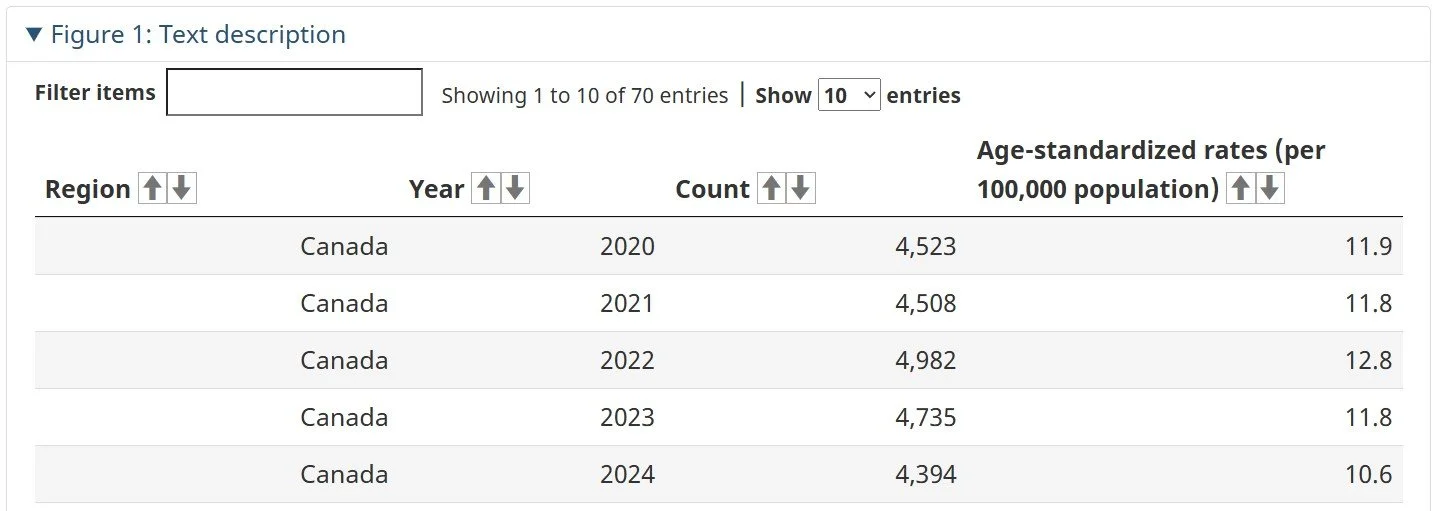
*2024 figures are listed as preliminary and may be revised.
Even here, where totals rise and fall from year to year, the broader pattern is stability with a recent decline—not the dramatic surge claimed at the press conference.
Why this matters
This is a common misinformation tactic: present a selective slice of data and hope the audience mistakes it for the full picture.
Many people understandably hear numbers delivered confidently in a formal setting and assume accuracy. Psychologists sometimes refer to this as the persuasive power of “sciencey” presentation—statistics, charts, and precise figures can create an impression of authority even when context is missing.
That appears to be what happened here.
A raw number on its own can be technically true yet still misleading if it omits the denominator. In public health, the denominator matters. Population growth matters. Rates matter.
If someone is making national claims about suicide trends, they should understand a very basic principle of statistical literacy: counts alone do not tell you whether a rate is increasing.
Failing to grasp that is not a minor oversight. It is the central error in the argument.
What to know
No matter which official Canadian dataset is used, the claim that suicide rates are rising sharply in Canada is not supported.
A key takeaway is that even official data can appear differently across databases depending on how it is organized, updated, or categorized. That makes it very easy for someone to cherry-pick figures that appear to support a preferred narrative while ignoring other equally available data that tells a different story. It is even easier when most people are unlikely to dig through the source tables themselves to verify what they have been told. And when essential context is omitted—such as Canada’s population growth over the same period—the result can be a claim that sounds factual while being fundamentally misleading.